
Video from Pastor Mike: Be Joyful in God!
Video From Pastor Mike: Three Storms in Scripture
Video from Pastor Mike: Let’s Check Our Perspective
Video from Pastor Mike: Suffering & Glory
Video from Pastor Mike: Don’t Forget God!
VIDEO: Quick Note from Pastor Mike
One Giant Leap
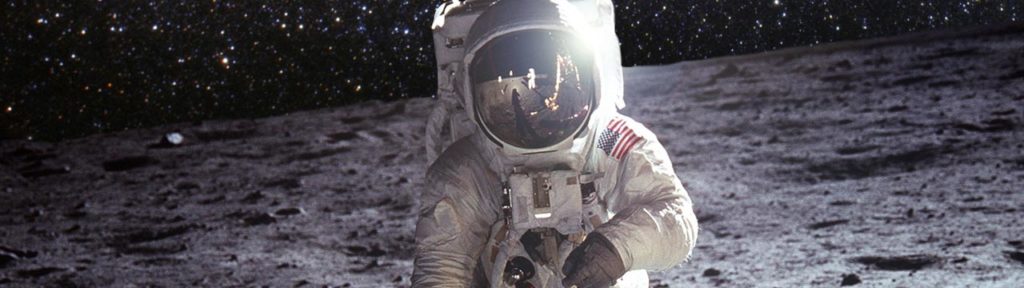
How well I remember where I was when Apollo 11 landed on the moon.
I was 25, and that event eclipsed anything I had experienced as an American citizen. Webster would be at a loss for the right word to describe this event. So I salute those who made this possible. However, there is a fly in the ointment, a disillusionment if you will. You see, this event birthed the possibility of a future utopia. So the following is a brief review of where man’s supreme intellect has taken us.
Imagine this: You are 25 years old and the year is 1969. Apollo 11 has just landed on the moon and these famous words spoken by Neil Armstrong from outer space will echo down through the ages: “That’s one small step for man, one giant leap for mankind.”
The lunar landing was a technological achievement of epic proportions. This historic chapter in American history engendered much speculation about future hopes and dreams. If mankind’s collective knowledge could achieve such a feat, what else might the future have hidden away in its secret chambers? We’ve conquered Earth and now the moon—is there any frontier that our inexhaustible knowledge can’t conquer?
So again, let’s imagine. Following such a marvelous breakthrough, you are invited to hear a futurist—we’ll call him “Professor Jones”—predict what lies ahead. The world is poised for another big leap and Professor Jones is ready to take you on a journey you will find hard to believe, much less envision. A thousand young people flood the auditorium to hear about the limitless possibilities of the future.
After an introduction of Jones’ qualifications, which include numerous books, accolades and articles published in scholarly journals, the distinguished professor mounts the podium to enthusiastic applause, which he humbly acknowledges. Based on the amazing technological accomplishment of the recent lunar landing, he begins to give a compelling and positive outlook for what lies ahead.
With his expertise, foresight, and calculations, Professor Jones predicts a very bright future thanks to man’s continued technological advances. The audience is understandably pleased with such an assessment. After all, it is 1969 and we have just witnessed a man walking on the moon—the possibilities are limitless! The professor’s basic premise is that large mainframe computers will dramatically shrink in size and dramatically increase in ability. Computer memory and processing capabilities will grow at an exponential rate. Problem-solving will take seconds instead of months or years. Complex calculations once hand-written across dozens of chalkboards will be done in a fraction of the time.
The audience is spellbound, but our gifted futurist is just warming up. He senses the anticipation of his listeners, and he greatly enjoys feeding them morsels of future hope one bite at a time.
Then comes the grand finale of his prophetic vision for our coming technological utopia. He predicts that by the year 2019, just fifty years after the historic moon landing, computers will be held in our hands with a million times more data and processing power than the present behemoths that occupy large rooms and require extensive cooling systems. In fact, this massive technology will become so small, it could fit on your desk, be carried in your briefcase, or even rest in the palm of your hand. This innovative miniature handheld device will take your breath away.
He ventures out on a very long limb and draws the crowd into the most fantastic story they have ever heard. The eyes and ears of his audience are captured, and there is no escape.
With animated hand gestures choreographed to his every word, Jones weaves a future tale that is more than compelling. Even through their stunned disbelief, the audience can taste what lies ahead. He says:
These miniature computers will become your life. They will serve as telephones with no limits as to who you can call. You will be connected to everyone and everything at all times! Entire libraries of information will be accessible there in the palm of your hand! You will have access to medical help in seconds. These devices will count your calorie intake and remind you what to eat at your next meal.
Forget the postal service taking weeks to deliver correspondence to long-distance destinations. Your letters can be sent digitally across the globe in a literal instant!
Trouble in your marriage? No problem. Your personal miniature computer comes equipped with a viewing screen of exceptional clarity and dazzling color. You and your spouse can watch a marriage seminar anytime for help.
Struggling emotionally? There will be instant counsel and encouragement always at your fingertips.
Rebellious children? You will know where they are at all times with a tracking device on your little handheld friend.
Schools will no longer have to worry about the major public school issues of our day: boys pulling girls’ hair, running in the hallways, smoking out back or bullying each other by name calling. With the extensive knowledge available to our youth, those days of such base and barbaric behavior will fade away as our technological future grows brighter and brighter.
Bored while you wait in the doctor’s office? An endless choice of TV and movies will be at your disposal in vivid color. Want to read a novel? Just touch the screen and the pages of a million books will light up in front of you.
Get a new car, go on a fun vacation, or find a new diner? A new dress for little Sally? New puppy for young Jimmy? Share the joy of every moment with family, friends, and neighbors in an ever-connected web of social bliss.
No need to waste gas driving to department, hardware and grocery stores! Your device will be a hub of commerce. Anything you could ever want and more can be purchased and delivered directly to you at your command. Think of the time and money you’ll save!
You can get exact updates on your finances, medical history, workout routine, and you can read recent articles on your favorite subjects any time, any where. Any information you want, from sports to history, science to art, philosophy to mathematics—it will all be available at your slightest whim. No more card catalogues at the library to sift through. Immeasurable knowledge will be available in an instant, in dramatic color, easily accessible whenever and wherever you desire.
All of the leisure and pleasure and education and personal connection you can imagine will be within easy reach. And it will be affordable enough that any of you can partake.
Then he puts the icing on the cake.
With all of this technological power literally at your fingertips, work days and work weeks will be cut in half. Stress will be a thing of the past. Knowledge will increase at a profound rate, and with that will come the end of health issues, financial worries, social problems. Life will be easy. What more could one ask of the future?
The crowd finds all this hard to believe (even though we’ve just landed on the moon), but the good professor speaks with great authority, and he is most convincing. Everyone leaves the seminar feeling very confident about their future and the future of the world thanks to the genius of our ever-advancing technology.
Now, as far as I know, no “Professor Jones” went around making all of these grand claims about the future in 1969. But what if there were? Can you imagine hearing those words, envisioning those promises of a problem-free utopia just around the corner?
We are now fifty years removed from that famous landing on the moon. How did our fictitious futurist do? In terms of technological advancement, he nailed it. The computing power that sent astronauts into space fifty years ago has nothing on the device you are reading right now. We have incalculable knowledge, entertainment, and utility available at our fingertips.
But what about Professor Jones’ prediction that all of this grand technology would make our lives easy and take away all of our problems?
Are marriages today better or worse? Is mental illness greater or less? Has suicide increased or decreased? What about bankruptcy? Obesity? Anger? Hate? Sickness? Depression? Anxiety? Loneliness? National debt? Did that anticipated shorter work week come to pass? Is life less stressful or more so? We all know the answer to these questions. The vision of technology that had enraptured our hypothetical 1969 audience failed to deliver. “That’s one giant leap for technology, one gigantic letdown for mankind.”
It seems logical that an exponential rise in knowledge should result in an exponential decrease in problems. But sadly, such is not the case. You name it and it has gotten worse. From a natural perspective, it makes no sense at all—but like it or not, even with our increased knowledge and technology, increased problems are observable, reproducible, and measurable on a daily basis. How can this be? Simply put, man is addicted to knowledge but allergic to wisdom. There’s no question that our increase in knowledge has lead to incredible discoveries and technological advancements. But knowledge is only part of the equation. We’ve forgotten the key component—wisdom.
Wisdom is the proper application of knowledge. Gaining knowledge is one thing; what to do with that knowledge is another thing entirely. Therein lies the problem. Knowledge is a good thing, but only when it is applied how God meant for it to be applied. Otherwise, knowledge divorced from wisdom is a train wreck.
You have a great advantage if you hold Scripture as the ultimate authority on man and our future. Thanks to the wisdom of the Word, we ought not fall for the illusion that life gets better by virtue of mere knowledge and technology. Scripture reveals to us that knowledge inflates not only our brains, but our pride (1 Corinthians 8:1), and pride leads ultimately not to societal utopia, but to destruction (Proverbs 16:18).
So how do we avoid this trap? Again, Scripture shows us the way. Along with knowledge and understanding, we are to pursue wisdom as the “principal thing” because it is wisdom—the proper application of knowledge—that guards and preserves us by allowing knowledge to become an “ornament of grace” instead of an all-you-can-eat buffet for our pride (Proverbs 4:5-9, KJV). Wisdom dictates that we should be wary of becoming people who are “always learning, but never able to come to knowledge of the truth” (2 Timothy 3:7) because knowledge has never been an end unto itself. Rather, knowledge when properly (wisely!) applied will lead not to pride, but to truth, and it is truth—not technology—that will set us free. Where then might we find such truth? Jesus Himself tells us plainly: “If you abide in My word, you are truly My disciples, and you will know the truth, and the truth will set you free” (John 8:31-32).
Abiding in the Word of God is key. More compelling than any futurists’ predictions, the Bible points us to the person of Jesus Christ as the ultimate source of truth, knowledge and wisdom; He is the true Savior who alone stands as “the radiance of the glory of God and the exact imprint of His nature” (Hebrews 1:3). What greater truth could ever be revealed to us than to know the Lord Jesus Christ, who holds both wisdom and knowledge in perfect balance (Colossians 2:2-3)? Because “all things were created through Him and for Him” (Colossians 1:16), the promises of Jesus are far greater than anything the world offers. While we may be tempted to find hope in Professor Jones’ vision of technological advancement, only God’s Word contains the truly good news that people are so frantically seeking.
Jesus alone is a Savior in ways that no achievement or technology could ever come close to. While I’m grateful for the wisdom and knowledge God makes available to us, it is by faith that we come to Jesus (Hebrews 11:6, Ephesians 2:8-9). The steps that lead us to Him are the greatest we will ever take because while landing on the moon was truly an awesome human accomplishment, it doesn’t compare at all to knowing the One who placed it there.
“My goal is that they may be encouraged in heart and united in love, so that they may have the full riches of complete understanding, in order that they may know the mystery of God, namely, Christ, in whom are hidden all the treasures of wisdom and knowledge” (Colossians 2:2-3, NIV).
You’re a Mother

You’re a mother – and the evidence of this sobering fact bears heavily upon your emotional constitution with every passing day. You’ve changed diapers, wiped runny noses, cooked ten thousand meals and washed as many floors. You either have, or will experience all the stages attendant with this great title.
The first stage demands your constant attention as your “candle goeth not out by night” explaining that ghosts don’t exist or that nightmares are nothing to worry about. Morning comes sooner than you would like with its verbal barrage of “Billy hit me,” “David’s trying to eat his cereal with a fork!” “Have you seen my underwear mom? Huh? Huh?” You have learned by experience that facing the music at this early hour is merely the prelude of what is to follow. By nightfall, you’ve had it. If you hear one more question like “Do worms yawn?” or “Where does the white go when the snow melts?” you’ll scream. Each day takes its toll, and you pay it faithfully – because you’re a mother.
Like a tidal wave, the teenage years break upon the shore line of your life, unannounced and unprepared for. You trade in your bib for boxing gloves. New demands and new challenges force your hand. Nursery rhymes won’t cut it. You’re a counselor whose sensitivity and advice must be couched in love. You’re dealing with tender hearts that question self-worth and life’s values, but you’re always there – because you’re a mother.
As your children leave the nest, you pose for a different picture. You’re a grandmother – and this mountaintop experience offers a breathtaking view of the past, present and future. It gives you a chance to experience the contentment of knowing that you have helped to landscape the lives of those whom God lovingly calls “the fruit of the womb.” You’re a bit older and a bit wiser now, and if the truth were known, you wouldn’t trade it for anything.
It is for this reason that today and everyday we rise up and call you blessed – because you’re a mother.
The Binary Gospel

The term binary is not a new one, but it has made its way into our everyday vocabulary thanks to computer technology.
Here is how the word is defined by the Oxford dictionary: “Relating to, composed of, or involving two things.” Much of life is binary: two things paired together in a way that brings focus and clarity. Up or down, east or west, black or white, in or out, active or passive, true or false—they are all binary.
The beauty of binary is that there is no wiggle room. Nothing is fuzzy or unclear. In binary computer code, ones are not zeros, and zeros are not ones. This binary nature is what makes the true Gospel clear in contrast to religion, which clouds the issue regarding eternal life. While religion blurs the edges, the binary Gospel brings life into sharp focus. Let’s take a look at a few binary statements made in Scripture about the Gospel.
“Very truly I tell you, whoever hears my word and believes him who sent me has eternal life and will not be judged but has crossed over from death to life” (John 5:24). Here you have two binary opposites. You have either passed from death to life and will escape judgment, or you haven’t.
“Whoever has the Son has life; whoever does not have the Son of God does not have life” (1 John 5:24). Binary again. You either have the life in the Son or you don’t.
“For he has rescued us from the dominion of darkness and brought us into the kingdom of the Son he loves,” (Colossians 1:13). You have been rescued or you haven’t. You are in the Kingdom or you are not.
“I tell you the truth, no one can see the kingdom of God unless he is born again” (John 3:3). You are either born again or you are not.
“Therefore, since we have been justified through faith, we have peace with God through our Lord Jesus Christ” (Romans 5:1). You either have peace with God or you don’t. Starting to get the picture?
“Therefore, there is now no condemnation for those who are in Christ Jesus.” (Romans 8:1). No middle ground here. You are either condemned or you are not.
“For the Son of Man came to seek and to save the lost” (Luke 19:10). You are either saved or lost. Zero or one—not both.
“For it is by grace you have been saved, through faith—and this is not from yourselves, it is the gift of God—not by works, so that no one can boast” (Ephesians 2:8,9). You are saved by faith or you are not. It is a gift or it is by works. It cannot be both.
I could keep going, but I think you see my point. The default mode of the human heart is to blur the lines, and the lines will always be blurred when human effort or good works are involved. Note how fuzzy things get if we were to take any of the above verses and add the haze of religious effort to it. “For it is by grace you have been saved—as long as you go to church and occasionally drop a twenty in the offering plate.” “I tell you the truth, no one can see the kingdom of God—unless he tries real hard to keep the Golden Rule.” Is it grace or good works that saves me? And how hard to I have to try to keep the Golden Rule?
I often wonder at the heart of man, that he feels such a need to help God out by adding to the clarity of His Word. When Jesus said “It is finished” at the cross, why do we think we need to add a few finishing touches? Would we try to improve a Rembrandt? And if we did, would it enhance or detract from the masterpiece? The question is rhetorical, but the answer is not: Christ has already done it all on my behalf. What could I possibly add to it?
So if you find yourself struggling, just remember this: God did not send His Son to leave us confused about our eternal destiny. You are either condemned or you are not.
You’re either in the kingdom, or you’re out of it. You are saved by grace through faith or you are not. You either have the life in the Son, or you don’t.
While religion will always cloud the beautiful clarity of the binary gospel, the Scriptures are clear; it’s all of Jesus, or none of Him. IT’S BINARY.
Apples and Oranges: Is the World Getting Better or Worse?

I have often said, in sermons and in conversation, that the world is not getting better, but is actually getting worse. This sometimes meets with pushback from people who see the accomplishments of recent decades as evidence of our great progress. They have a good point, and here is why.
They remind me that we are living longer, and that the latest surgical procedures and medical advances are keeping people alive who otherwise would have died. We have access to knowledge and education like never before. We can FaceTime with friends across the globe. We can go online and check out medical issues that, in times past, might have taken weeks or even years to diagnose. Compare that to people in Rome in the first century, who were exposed to horrible conditions and disease. Ancient Babylon was even worse. Certain advances in medicine and technology have changed our lives for the better.
I totally agree with all of the above, and I could add a lot more to the list.
But at this point, I want to make myself very, very clear. The examples we’ve mentioned, which could be magnified many times over, are what I will call the apples. Apples are the good things, the discoveries and inventions that have bettered our world.
On the other end of the spectrum, we have what we can refer to as the oranges—these would be the addictions, insomnia, diseases, suicide, depression, bankruptcy, divorce, child abuse, sexual abuse, eating disorders, binge drinking, hate, gluttony, and a host of other maladies that are on an exponential rise and plague the world. Many, many people are drowning in troubles that we never anticipated in our pursuit of progress. And there is no sign that those troubles are slowing down.
So in contrast to apples, the oranges are those hurtful, evil things in the world that continue on, despite our growth in areas of technology, medicine and education.
Much confusion comes when we mix the apples and the oranges. So the question remains: Is the world getting better or worse? The answer depends on how you weigh the data. It may seem like there are more apples than oranges, or that at least the apples and the oranges cancel each other out. But let’s zoom in and take a closer look at the issue by turning to the Scriptures, our only source of authority. We will look at two passages that, I believe, need no special interpretation. Read carefully what Jesus says in the following text:
What comes out of a person is what defiles them. For it is from within, out of a person’s heart, that evil thoughts come—sexual immorality, theft, murder, adultery, greed, malice, deceit, lewdness, envy, slander, arrogance and folly. All these evils come from inside and defile a person. (Mark 7:20-23)
Note that Jesus is not singling out some wicked individual. He is talking about you and me. He is revealing that all people have the disease of sin in their hearts, and He gives no indication that this malady will improve with time and progress.
Let’s take a look at another verse. This is from the apostle Paul.
But mark this: There will be terrible times in the last days. People will be lovers of themselves, lovers of money, boastful, proud, abusive, disobedient to their parents, ungrateful, unholy, without love, unforgiving, slanderous, without self-control, brutal, not lovers of the good, treacherous, rash, conceited, lovers of pleasure rather than lovers of God—having a form of godliness but denying its power. Have nothing to do with such people. (2 Timothy 3:1-5)
What I want us to see here is that all of these evil bents have been with humanity since Adam and Eve sinned. Yet Paul is quite clear that they will only increase over time, growing worse and worse until the time the Lord returns. We could go through each issue at length, but I have selected just three.
Lovers of themselves: People have always been narcissistic and focused on themselves. But today we have a magazine called Self, we take selfies, read self-help books, we practice self-love and self-care to improve our self-esteem. Paul could not have imagined our technological advances, but he knew that people would always be looking to take advantage of any advancement that promotes “Me.”
Lovers of money: Man has always had an affair with money, but the ability to gain it, leverage it, lend it, borrow it, and invest it is well beyond what anyone thought possible in the first century. Yet an affair with money is still an illegitimate affair. Love of money has led to divorce, excess, neglect of the family, and a myriad of other problems—many of which can be found in Jesus’ list in Mark 7:20-23.
Disobedient to parents: This is not a new problem either, of course, but the epidemic of rebellion seems far greater than before. I have been able to see it in my own lifetime. The biggest problems in the public school system in the late 50s and early 60s were pulling girls’ hair, running in the halls, and smoking out back. These are not the problems of today. An avalanche of depression, sexting, teen pregnancy, drugs and other R-rated issues now fill the principal’s inbox on a daily basis. And in television, Ozzie and Harriet, Father Knows Best, Leave It to Beaver, and The Andy Griffith Show used to have one thing in common: a father who led the home with integrity and was respected by his children. But today technology has made it possible for children to watch endless hours of shows that paint the parents as buffoons and the children as the real authorities in charge. Video games, movies, books and other avenues that promote this skewed dynamic have captured the hearts and minds of our youth.
Perhaps the most interesting thing about the list that Paul gives us is that he never should have made such a prophetic statement. Anyone living at the time would have known that man is intelligent and will one day conquer all these problems. With all of our advancements in knowledge, education, technology, and medicine, such a dire prediction of the last days is absurd. All of our apples should reduce the friction Paul predicted would happen. But Paul was under the inspiration of the Holy Spirit to write what he wrote, and he makes it clear that the oranges remain. So who is right; those who have predicted utopia? Or Paul, who predicted perilous times?
If you’re talking only about the apples, then all is well! But if you consider the oranges, the prospects look pretty bleak. Living longer, being safer, having air conditioning, and getting laser surgery to give you 20/20 vision are not the real issues at hand. The real issue is the human heart. It has always been “evil from its youth” (Genesis 8:21), but now it has more opportunity, largely through technology, to pursue or express that evil for longer periods of time. Paul may have never known about computers, but his list of sins in 2 Timothy 3 was his way of predicting that evil would go viral.
So I hope this is clear. I thank God for the good gifts he has given mankind that have helped us navigate the deep waters of physical pain and make life more tolerable. If Heaven were gained by good works, then the man who invented novocaine would be the first to enter. I’m grateful for the technology that allows me to communicate with people around the world. I’m amazed at the unprecedented access to knowledge we have in these current days. These are good apples for which I am grateful. However, the bad oranges that plague the whole world are produced daily by hearts that have not been redeemed, and sometimes, even by hearts that have. This is why we, as believers, are not to get attached to this world. Because of sin, this world is in darkness and decay. Pile on as many apples as you want – those rotten oranges remain. Does that mean we shouldn’t try to produce as many apples as we can? By no means! We as believers are here to bring light to show the way out of the darkness and to be salt to impede the decay. But let’s be clear about where our hope lies. No amount of education, medicine, or technological advancement can cure the wickedness of the human heart (Jeremiah 17:9). As great as those advancements are, they only deal with the symptoms of our plight, not the root cause. If Jesus is correct, the real issue is that evil rises up from within. We see the external effects of evil, but evil is not primarily an external issue. Evil is a heart issue. And while apples may fill the belly, they can never redeem the heart.
The point of all of this is not to doom-and-gloom you into depression. It’s to help us see that the bad news is really bad, so that we can remember that the Good News is really good. The world is getting worse, and no amount of medical, intellectual, or technological advancement can stem the tide. If evil comes from inside a person, as Jesus claims, then we are the problem. And as I have said many times, when the problem tries to solve the problem—well, that’s a problem. The world is helplessly broken and cannot fix itself.
But ultimately, we are not called to put our confidence in the apples, nor to despair over the oranges, but rather to rest in the finished work of Christ. In Him, we can have hope and joy no matter what is happening in the world around us. For those who believe in Him, the One who is “making everything new” (Revelation 21:5), the world will be better someday, and for all eternity.
As for you, you were dead in your transgressions and sins, in which you used to live when you followed the ways of this world and of the ruler of the kingdom of the air, the spirit who is now at work in those who are disobedient. All of us also lived among them at one time, gratifying the cravings of our flesh and following its desires and thoughts. Like the rest, we were by nature deserving of wrath. But because of his great love for us, God, who is rich in mercy, made us alive with Christ even when we were dead in transgressions—it is by grace you have been saved. And God raised us up with Christ and seated us with him in the heavenly realms in Christ Jesus, in order that in the coming ages he might show the incomparable riches of his grace, expressed in his kindness to us in Christ Jesus. For it is by grace you have been saved, through faith—and this is not from yourselves, it is the gift of God—not by works, so that no one can boast. For we are God’s handiwork, created in Christ Jesus to do good works, which God prepared in advance for us to do. (Ephesians 2:1-10)